Affordable ERP Solutions for Growing Businesses [How to Choose a System That Fits]
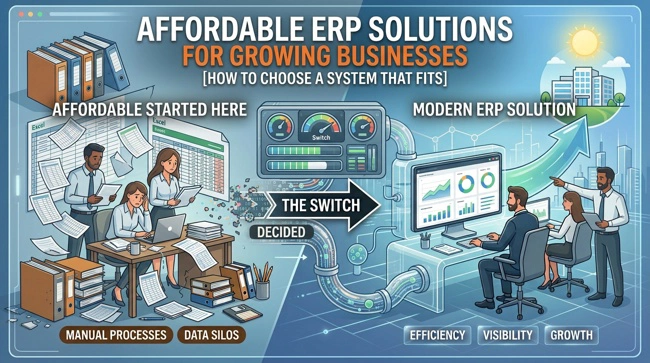
Growing a business is exciting, but growth often exposes problems that were easy to overlook when the company was smaller. A spreadsheet that once handled inventory may become difficult to maintain. Employees may enter the same customer information into several systems. Financial data can reside in one application, while sales, purchasing, inventory, and reporting are managed elsewhere.
At that point, many business owners start looking for affordable ERP solutions for growing businesses. The challenge is finding an ERP system that provides enough capability to support growth without introducing the complexity, expense, and disruption often associated with large enterprise software.
The right ERP does not have to be the biggest system on the market. It needs to be the right system for the way your business operates today while giving you room to grow tomorrow. For small and mid-sized businesses, that distinction can make the difference between software that becomes a valuable operational tool and software that becomes another expensive problem.
What Are Affordable ERP Solutions for Growing Businesses?
An enterprise resource planning (ERP) system brings important business processes into a connected environment. Depending on the business, an ERP may manage inventory, purchasing, sales, financial information, reporting, customer information, workflows, and other operational activities.
For a growing business, affordability should not simply mean choosing the software with the lowest monthly price. A low-cost system that requires extensive workarounds, manual data entry, expensive customization, or constant technical assistance may cost more over time than a properly designed solution.
Affordable ERP solutions for growing businesses should therefore be evaluated based on total value. That includes software costs, implementation, integrations, training, ongoing support, scalability, and the amount of administrative work the system can eliminate.
Praxis Blueprint approaches ERP from this practical perspective. The company's ERP offering is designed around inventory management, purchasing, reporting, and operational control, with customization and integration capabilities intended for small and mid-sized businesses.
Why Growing Businesses Start Looking for ERP Software
Most small businesses do not wake up one morning and decide they need an ERP system. The need usually develops gradually.
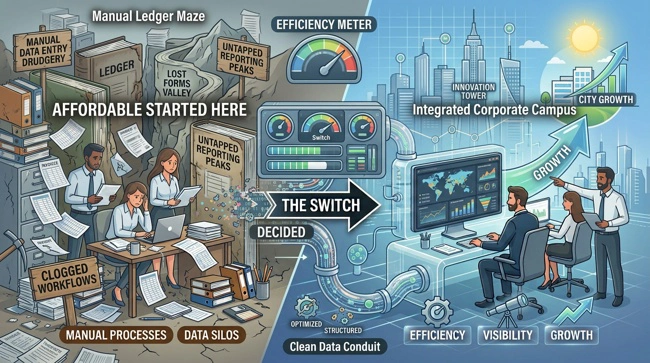
A company might begin with spreadsheets, QuickBooks, a point-of-sale system, an e-commerce platform, and a few other applications. Each tool solves a specific problem, so everything appears manageable. However, as sales increase and employees are added, the number of connections between those systems also increases.
Someone has to export sales information. Someone else updates the inventory. Another employee reconciles accounting records. Managers may create reports manually because the information they need is spread across several systems.
This is often the point at which business owners realize their problem is not necessarily a lack of software. It is a lack of connection between the software they already have.
An ERP can provide a central operational framework that brings these processes together. Instead of constantly moving information between systems, employees can work from more consistent and accessible data.
How to Know If Your Business Is Ready for an ERP
There is no universal employee count or revenue figure that determines when a business needs ERP software. A company can be relatively small and still have complex operations, while another company can be larger and continue using simple tools effectively.
The better question is whether your existing systems are helping the business or forcing employees to work around them.
Common warning signs include increasing duplicate data entry, frequent inventory discrepancies, difficulty producing accurate reports, disconnected accounting and sales information, and employees maintaining their own spreadsheets to compensate for limitations in existing software.
Another important warning sign is that the owner or manager has become the person responsible for keeping everything together. If important operational information depends on one person's spreadsheets, memory, emails, or manual reports, the business may have developed a significant operational risk.
What Makes an ERP Solution Affordable?
The word "affordable" means different things to different businesses. For a startup, affordability may mean minimizing upfront costs. For an established retailer, it may mean reducing inventory errors and administrative labor. For a growing service company, it could mean having better visibility into jobs, schedules, invoicing, and financial performance.
A useful way to evaluate affordability is to look beyond the purchase price and consider the system's expected business impact.
| Cost or consideration | What to evaluate |
|---|---|
| Software | Licensing, subscriptions, users, modules, and usage costs |
| Implementation | Configuration, data migration, integrations, and deployment |
| Training | Employee onboarding and ongoing education |
| Support | Availability of technical and business support |
| Customization | Whether workflows can be adapted without excessive development |
| Integration | Connections with accounting, CRM, POS, e-commerce, and other systems |
| Efficiency | Time saved through automation and reduced duplicate work |
| Scalability | Whether the system can support additional locations, users, products, or transactions |
A system that costs slightly more initially but eliminates hours of manual work every week may be considerably more affordable over its useful life.
This is one reason Praxis Blueprint emphasizes practical systems rather than bloated enterprise packages. Its stated positioning is to provide powerful business management capabilities without forcing smaller businesses into unnecessary complexity and cost.
Cloud-Based ERP Solutions for Growing Businesses
Cloud-based ERP software has become an attractive option for businesses that want access to business information without maintaining extensive on-site infrastructure. Depending on the implementation, cloud deployment can make it easier for authorized employees to access systems from different locations while reducing some of the hardware responsibilities associated with traditional on-premises deployments.
For a growing company, this can be especially useful when employees work across multiple locations or when management needs access to current operational information outside the main office.
However, "cloud-based" should not automatically be treated as synonymous with "better." Business owners still need to understand how data is stored, what integrations are available, how backups and security are handled, what support is included, and how the system can be customized.
The goal should be to choose technology that makes the business easier to operate, not simply technology that happens to use a particular deployment model.
ERP Integration With QuickBooks, CRM and Other Business Tools
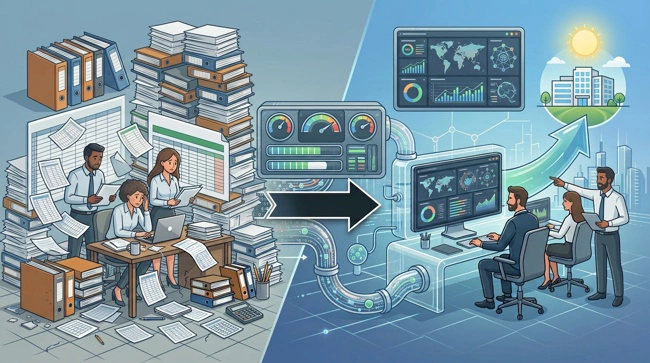
One of the biggest advantages of a well-designed ERP strategy is the ability to connect the systems a business already depends on.
For example, a business may use QuickBooks for accounting, a CRM for customer relationships, an e-commerce platform for online sales, and a separate inventory solution. Replacing everything may not be necessary. In many cases, the better approach is to determine which systems should remain in place and then connect them appropriately.
Integration can reduce repetitive data entry and help different departments work from more consistent information. Praxis Blueprint specifically identifies system integration and automation as a core service, including connections involving QuickBooks, inventory systems, e-commerce platforms, and CRM software.
Custom ERP Systems vs. Off-the-Shelf Software
Growing businesses often face a choice between adopting an off-the-shelf ERP product and implementing a more customized system.
Off-the-shelf software can be a good fit when a company's processes closely match the way the software operates. It can provide established functionality and may be faster to deploy.
Customization becomes more valuable when a company has unique workflows, specialized reporting requirements, unusual inventory processes, or integrations that generic software cannot handle effectively.
The key is balance. Customization should solve a real business problem rather than exist simply because customization is possible.
Praxis Blueprint's approach is centered on building systems around actual business workflows instead of forcing companies into generic templates. That philosophy is reflected in its positioning and competitive advantages, which emphasize custom-fit solutions and integration expertise.
How ERP Software Can Improve Operational Control
Growth creates more transactions, more employees, more customers, and more decisions. Without connected systems, that growth can make it increasingly difficult to understand what is happening inside the business.
ERP software can provide a more centralized view of operations. Managers may be able to monitor inventory, purchasing, sales activity, financial information, and other business metrics without waiting for several employees to assemble separate reports.
The benefit is not simply having more dashboards. The real value comes from having information available when it is needed and reducing the manual effort required to produce it.
For example, a retailer with integrated inventory and sales information may be able to identify low-stock products more quickly. A growing service business may gain better visibility into jobs and invoicing. A multi-location operator may have an easier time comparing performance across locations.
The objective is clarity. Technology should help the owner understand the business rather than create another layer of complexity.
Affordable ERP Implementation Requires Planning
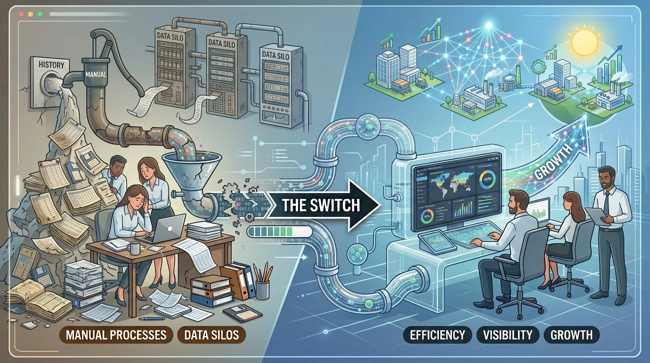
Choosing affordable ERP solutions for growing businesses is only part of the process. Implementation deserves just as much attention.
A business can purchase excellent software and still achieve disappointing results if its processes, data, integrations, and employees are not properly prepared.
Before implementation begins, businesses should document how important processes currently work. This includes sales, purchasing, inventory, accounting, customer management, reporting, and other workflows relevant to the organization.
The implementation team should then identify which processes should remain unchanged, which should be improved, and which should be automated. Data migration should also be planned carefully because inaccurate or poorly structured data can create problems in the new system.
Employee training is equally important. A technically successful implementation is not necessarily a business success if employees do not understand how or why to use the system.
How Much Does ERP Implementation Cost?
There is no single ERP implementation price that applies to every small or mid-sized business. Costs can vary substantially depending on the number of users, business processes, integrations, data migration requirements, customization, training, deployment model, and ongoing support.
A business should be cautious about choosing a system solely because it advertises a low starting price. The initial subscription or software fee may represent only one part of the total cost.
A more useful approach is to ask prospective ERP providers for a clear breakdown of implementation costs and ongoing expenses. Businesses should understand what is included, what may be charged separately, how integrations are handled, and what support is available after deployment.
Praxis Blueprint's broader philosophy is to focus on practical solutions and honest recommendations rather than pushing unnecessary technology. Its brand values specifically emphasize recommending what is right for the business, even when that means building something smaller or advising a customer not to buy what is being offered.
Choosing the Right ERP Partner for a Growing Business
ERP implementation is not simply an IT project. It affects how employees work, how information moves through the company, how managers make decisions, and how the organization grows.
For that reason, the implementation partner matters almost as much as the software itself.
Look for a provider that takes time to understand your business before recommending a system. The right partner should be able to explain technical concepts in straightforward business language, identify inefficiencies in existing workflows, discuss integration requirements, and provide realistic guidance about implementation.
This approach is particularly important for small business owners who may not have an internal IT department. Praxis Blueprint's target customers include entrepreneurs, startups, growing companies, multi-location operators, and professional service providers, with services designed around their practical operational needs.
When Affordable ERP Solutions Are Worth the Investment
The right ERP solution should ultimately make the business easier to run.
That might mean fewer spreadsheets, less duplicate data entry, faster reporting, better inventory visibility, more consistent processes, or easier management of multiple locations. In some cases, the most important benefit is simply giving the owner confidence that the information being used to make decisions is current and reliable.
ERP software should also be viewed as part of a broader business systems strategy. A company may eventually connect its ERP with its POS, CMS, accounting platform, CRM, e-commerce system, or other applications.
Praxis Blueprint's broader vision is to make powerful business systems accessible and genuinely useful to small and mid-sized companies, with a focus on connecting processes and eliminating unnecessary manual work.
Frequently Asked Questions About Affordable ERP Solutions
What is the best ERP system for a growing small business?
There is no single ERP system that is best for every growing business. The right choice depends on the company's workflows, industry, number of users, integrations, reporting needs, budget, and growth plans. A business should evaluate how well the system fits its actual operations rather than selecting software based only on the number of features it offers.
How much should a small business spend on ERP software?
There is no universal budget because ERP costs depend on implementation complexity, users, integrations, customization, training, and support. Businesses should evaluate total cost of ownership and expected operational benefits instead of comparing subscription prices alone.
Can ERP software replace spreadsheets?
In many cases, ERP software can replace spreadsheets used for operational processes such as inventory, purchasing, reporting, and workflow management. Spreadsheets may still be useful for analysis or specialized tasks, but they should not become the backbone of processes that require shared, current and controlled information.
Can ERP integrate with QuickBooks?
Yes, ERP systems can be integrated with accounting platforms such as QuickBooks when appropriate integration capabilities are available. The exact approach depends on the software, business requirements, data being exchanged, and desired workflow.
Is cloud ERP suitable for small businesses?
Cloud ERP can be suitable for small businesses that want scalable access to business systems without managing extensive on-site infrastructure. However, businesses should evaluate security, support, integrations, data management, customization, and total cost before making a decision.
Do I need an ERP consultant?
An ERP consultant can be particularly valuable when a business has multiple disconnected systems, complicated workflows, significant data migration requirements, or uncertainty about which technology it actually needs. A consultant can help analyze existing processes and develop a practical implementation strategy.
Build a Business System That Can Grow With You
Growth should not mean adding more spreadsheets, more manual processes, and more disconnected software. When a business reaches the point where its existing tools are making operations harder rather than easier, an ERP strategy can provide a path toward greater visibility, consistency, and control.
The most affordable ERP solution is not necessarily the one with the lowest initial price. It is the one that solves meaningful operational problems, integrates appropriately with the systems you already use, supports your employees, and continues to provide value as the business grows.
For entrepreneurs and small-to-mid-sized businesses, that means starting with the business rather than the software. Understand how your company works, identify where time and information are being lost, and then choose technology that addresses those specific problems.
That is the philosophy behind Praxis Blueprint: practical business management systems designed around real businesses, with CMS, ERP, POS, integration, automation, and consulting capabilities working together to help owners move from disconnected processes to greater operational clarity.